In short: Tajweed is the set of rules that govern how every letter and word of the Quran should be pronounced. Learning it online has become the most accessible way for Muslims worldwide to recite the Quran correctly — from children just starting Noorani Qaida, to UK mothers wanting a female teacher, to adults polishing a lifetime of recitation. This guide explains what Tajweed actually is, the rules you need to know, how long it takes to learn, the difference between self-study and learning with a teacher, and how to choose the right online Tajweed course.
There’s a moment that comes for most Muslims who recite Quran regularly. You hear a qualified reciter — Mishary Alafasy, Abdul Basit, or one of the great sheikhs — and you realize, almost in an instant, how much you’ve been missing. The way the letters land. The pauses. The pull of certain sounds. The clean line between one letter and the next. That moment is the moment you understand why Tajweed exists.
This guide is written for anyone who has felt that moment and decided to do something about it. Whether you’re an adult starting from the alphabet, a parent enrolling your child, a UK Muslim mother looking for a female teacher, or someone who can already read but knows their recitation needs work — this is your starting point. We’ll cover what Tajweed actually is, why it’s a religious obligation rather than an optional polish, the rules you’ll need to learn, the time it realistically takes, and how to choose the right online course.
What Is Tajweed?
The Arabic word Tajweed (تَجْوِيد) literally means “to beautify” or “to make better.” In the context of the Quran, it refers to the science of pronouncing each Arabic letter correctly, from its correct articulation point in the mouth or throat, with the correct characteristics of weight, length, and emphasis.
Tajweed is what turns reading Arabic letters into reciting the Quran. Anyone can sound out the letters; Tajweed is what makes the recitation faithful to how the Quran was revealed to the Prophet ﷺ and transmitted by him to his Companions, who passed it on — letter by letter, mouth to ear — for fourteen centuries.
There are essentially two layers to it. The first is the science of articulation: where exactly in your mouth, throat, or nose each letter is produced, and what characteristics that letter carries. The second is the rules of recitation: when a letter is elongated, when it merges with the letter after it, when it becomes nasal, when it’s pronounced heavy, and when you can or must stop.
A student of Tajweed eventually moves from consciously applying the rules — “this letter needs to be held for two counts, this one needs ghunna” — to a state where correct recitation becomes automatic. The tongue learns the rules the way a musician’s fingers learn a scale. That fluency is the goal.
Why Tajweed Is Obligatory, Not Optional
Many Muslims assume Tajweed is a refinement — something you add when you want to recite beautifully. The classical scholars treated it differently. They considered the rules that prevent distortion of meaning to be a religious obligation, not a stylistic preference.
The Quran itself commands measured, careful recitation: “Recite the Quran with measured recitation (tartīl)” (Al-Muzzammil 73:4). And the Prophet ﷺ instructed: “Beautify the Quran with your voices.” Together, these establish that how you recite is part of what it means to recite.
The clearest practical argument for Tajweed is meaning. Arabic is a language where a single letter changes everything. Consider these pairs:
- Qalb (قَلْب) means “heart.” Kalb (كَلْب) means “dog.” The difference is one letter at the start.
- Tīn (تِين) means “fig.” Ṭīn (طِين) means “clay.” The difference is the heavy vs. light “t” sound.
- Sirāṭ (صِرَاط) means “path.” Sirāṭ with the wrong “s” sound becomes a different word.
A reciter who pronounces letters carelessly is, without realizing it, changing the meaning of the Quran. Tajweed exists to prevent that. It is the protective skill that lets you recite the Quran without distorting it.
The scholars distinguish between two types of mistakes. A laḥn jalī (clear error) — like mispronouncing a letter so badly that the word becomes a different word — is considered impermissible by most jurists. A laḥn khafī (hidden error) — like failing to elongate a Madd correctly — is generally seen as a flaw that should be corrected but does not invalidate the recitation. Tajweed, at minimum, prevents the first kind. With time, it eliminates the second too.
The Core Rules of Tajweed
Most online Tajweed courses are organized around six broad categories of rules. You don’t need to know any of them on day one — a good teacher introduces them in order, with examples from short Surahs you already recite. But here’s a map of what’s ahead.
Makhārij al-Ḥurūf — Articulation Points
This is the foundation. Every Arabic letter is produced from a specific point in the mouth, throat, lips, or nose. Some letters that look similar in English transliteration (like ح and ه, or ص and س) come from completely different places and sound completely different to a trained ear. The first stage of any Tajweed course is learning where each letter lives — and training your mouth to produce it from exactly that point.
For example, ع (Ayn) is produced from the middle of the throat. ح (Ḥā) is produced from the deeper part of the throat. ه (Hā) is produced from the deepest part. To an untrained reader they all sound similar; to a trained reciter they are unmistakably different.
Ṣifāt al-Ḥurūf — Characteristics of Letters
Each letter has inherent qualities — whether it’s heavy or light, whispered or voiced, soft or strong, whether the airflow continues or stops. These qualities are what give Arabic letters their distinctive sound. Mastering Ṣifāt is what separates a reciter who can pronounce letters from one whose recitation actually sounds like Arabic.
Rules of Noon Sākinah and Tanwīn
A “noon sākinah” is the letter ن without a vowel. “Tanwīn” is the doubled vowel marks at the end of words (ـً ـٍ ـٌ). When these are followed by certain letters, what happens to the noon sound changes. The four classical rules are:
- Iẓhār — pronounce the noon clearly.
- Idghām — merge the noon into the following letter.
- Iqlāb — convert the noon to a meem sound.
- Ikhfāʾ — hide the noon with a nasal sound (ghunna).
These four rules together govern dozens of words on every page of the Quran. They are some of the earliest rules students learn because the patterns repeat constantly.
Rules of Meem Sākinah
Similar to noon sākinah but for the letter م. There are three rules — Ikhfāʾ Shafawī, Idghām Shafawī, and Iẓhār Shafawī — depending on what letter follows.
Madd — Elongation
Some sounds in Arabic must be held for a specific count. The basic Madd is two counts (think of the aa in Allāh). Longer Madds are held for four or six counts depending on what follows the elongated letter. Getting Madd right is what gives Quran recitation its rhythm — too short and the recitation sounds rushed and choppy; too long and it sounds unnatural.
Waqf and Ibtidāʾ — Stopping and Starting
When you reach the end of a verse, you usually stop. But within long verses you’ll often need to pause to breathe, and where you stop matters. Some stopping points are mandatory, some are recommended, some are forbidden because they would break the meaning. Tajweed teaches you to recognize the marks in the Mushaf that tell you where to stop, where to continue, and where to choose.
These six categories cover most of what a beginner-to-intermediate Tajweed course teaches. More advanced courses cover the qirāʾāt (variant recitations), the rules of specific reciters like Ḥafs ʿan ʿĀṣim, and eventually the Ijazah pathway.
Common Tajweed Mistakes (And How They’re Fixed)
Most students who haven’t formally studied Tajweed make a small number of recurring mistakes. Recognizing them is the first step to fixing them. Here are the ones a good Tajweed teacher will spot in the first session.
Mixing similar-sounding letters. The most common pairs are ق with ك, ز with ذ, ح with ه, ص with س, and ط with ت. The fix is slow, patient drilling on each letter from its actual makhraj — the teacher will have you say the letter in isolation, then in a word, then in a sentence, until your tongue stops defaulting to the easier sound.
Skipping or shortening Madd. Most students rush. They read “ar-Raḥmān” with a short “a” instead of holding the elongation for two counts. The fix is exaggeration: a good teacher will have you over-elongate the Madd for weeks until the natural length feels right.
Missing Ghunna (nasal sound). When the rules call for a nasal sound, many students don’t apply it. Ghunna is what makes “min” sound nasal before certain letters. The fix is awareness — once a teacher points it out, most students can apply it within a week.
Stopping in the wrong place. Stopping mid-thought can change the meaning of an ayah completely. The fix is learning the waqf marks in the Mushaf and practicing slow, deliberate recitation with awareness of where verses naturally pause.
Reading too fast. This is the biggest underlying cause of all the other mistakes. Most beginners read at the speed of someone reading English — quickly, skimming. Quran recitation is slow by design. The fix is conscious slowdown for the first months. Speed comes naturally once accuracy is locked in.
How Long Does It Take to Learn Tajweed?
The honest answer depends on three factors: where you’re starting from, how much you study, and whether you have a teacher.
For a complete beginner who doesn’t yet know the Arabic alphabet, the path looks like this:
- Months 1–4: Noorani Qaida. Learn the alphabet, vowel marks, and basic letter combinations. Most students complete Noorani Qaida in two to four months at two or three sessions a week.
- Months 4–10: Basic Tajweed rules applied to short Surahs. Learn the rules of Noon Sākinah, Meem Sākinah, basic Madd, and Ghunna while reciting the short Surahs (Juz Amma, the last juz). By the end, you’ll be reciting short Surahs with applied Tajweed.
- Months 10–24: Full Quran with Tajweed. Apply the rules to all 30 juz, with the teacher correcting along the way. Most students complete a full khatm (read of the whole Quran) with Tajweed within twelve to twenty-four months.
For a student who can already read Arabic but never formally studied Tajweed, the timeline compresses significantly. Most reach competent applied Tajweed in three to six months of consistent weekly study.
For a student aiming for Ijazah — the formal certification — the timeline is years, not months. An Ijazah requires reciting the entire Quran to a qualified sheikh, often multiple times, with no errors. This is a serious commitment and the natural progression for adults who have completed basic Tajweed and want to go further. We’ve written a separate guide to the online Ijazah pathway for adults considering this track.
The single biggest determinant of how fast you progress isn’t talent or background — it’s consistency. Two sessions a week for two years will take you further than two months of daily intensive study followed by a year off.
Can You Learn Tajweed by Yourself?
Yes, partially. And in some areas, no.
What self-study can do well:
- Build familiarity with the rules conceptually
- Help you recognize the marks in a Tajweed Mushaf (the color-coded Qurans that highlight different rules)
- Train your ear through listening to qualified reciters
- Maintain consistency between teacher sessions
What self-study cannot do:
- Tell you when you’re pronouncing a letter wrong. Your ear is unreliable on its own native speech.
- Correct your makhārij. You cannot see where in your throat or mouth a letter should come from; a teacher hears it.
- Give you confidence that you’re actually reciting correctly. Most self-taught reciters carry mistakes they don’t know they have.
The honest truth is that Tajweed is an oral science. It was transmitted from teacher to student face-to-face for fourteen centuries, and there’s a reason for that. Reading about a sound and producing that sound are two different skills, and the gap between them is bridged by a teacher who can hear you.
This doesn’t mean you need to enrol in classes from day one. Many students start with apps, YouTube videos, and color-coded Tajweed Mushafs to build a foundation. But everyone we know who’s learned Tajweed properly has eventually worked with a teacher. The teacher catches the mistakes the student doesn’t know they’re making.
The most efficient approach for most adults: combine the two. Use apps and listening for daily practice, and book regular sessions with a teacher for correction. This blended approach progresses faster than either method alone.
Online Tajweed for Children
Children are some of the fastest Tajweed students you’ll meet. Their ears are still flexible, they can mimic sounds they’ve never heard, and they don’t carry years of accumulated bad habits. A child who starts Tajweed at six and studies consistently will often have better recitation by twelve than an adult who started later.
A few practical notes for parents.
Start around four to six. Earlier is fine for informal exposure — letting your child hear Quran around the house, learning short Surahs by listening, picking up letter names. Formal sessions usually click around age four to six, when the child can sit still for a structured thirty minutes.
Keep sessions short. Two sessions of thirty minutes a week is usually a better start than one sixty-minute session. Younger children fatigue quickly with intense focus.
Choose a teacher who’s good with children. This matters more than credentials at this stage. A qualified scholar who can’t connect with a five-year-old will frustrate both of you. Use the free trial sessions to evaluate this directly — sit in on the first session and see how the teacher talks to your child.
Pair Tajweed with Noorani Qaida. Most child programs begin with Noorani Qaida — the foundational primer that teaches the Arabic alphabet and basic pronunciation rules. Once the child completes Qaida (usually three to six months for younger children), they move to reading short Surahs with applied Tajweed.
Read along at home. Children practice what they hear. If you can recite a short Surah with Tajweed at the dinner table, your child’s progress will accelerate. If you can’t, listen together to qualified reciters — Mishary Alafasy is particularly clear and child-friendly.
For a fuller treatment of teaching children Quran online, see our parents’ guide to Quran memorisation for kids.
Online Tajweed for UK Muslim Women
For Muslim women in the UK — particularly mothers managing family responsibilities — online Tajweed classes have changed what’s practically possible. The combination of female teachers, flexible scheduling, and home-based learning has removed the friction that kept many women from formal Quran study for years.
A few things specifically worth knowing.
Female teachers are available for every course. This is one of the strongest cases for online classes. Most UK cities don’t have an easy supply of qualified female Quran teachers locally. Online, every reputable academy can match you with an Al-Azhar certified female teacher. The privacy of one-on-one online learning makes it comfortable in ways group settings often aren’t.
Schedule around the family. Sessions can be early morning before school runs, midday during school hours, evenings after children are in bed, or weekend mornings. The flexibility removes the “I just don’t have time” barrier.
Learn alongside your children. Many UK mothers we work with study Tajweed at the same time as their children — often with different teachers at staggered times. Children progress faster when they see their parents taking the same study seriously, and mothers find their own progress accelerates when they’re studying material their children are also learning.
Start with short sessions. Two thirty-minute sessions a week is usually a more sustainable starting point than longer sessions, particularly in the first months. As consistency builds, many mothers extend to sixty-minute sessions for deeper study.
Female-only group classes are also available. If you’d prefer to study with other women in your situation rather than one-on-one, some academies run small group classes of UK mothers studying together. Ask when you book your trial.
How to Choose an Online Tajweed Course
The teacher matters more than the platform, the price, or the schedule. Here’s what to evaluate before committing to an academy.
Verify the teacher’s credentials. A serious Tajweed teacher will have one or more of: an Ijazah in recitation, a degree from Al-Azhar University in Cairo, formal Tajweed certification, or substantial documented teaching experience. Don’t be shy about asking. A confident teacher will share their credentials happily.
Listen to a recitation sample. Ask the academy to send a short recording of the teacher reciting a few ayahs. Tajweed is audible — you can hear immediately whether the rules are being applied properly. If you don’t know enough to judge yet, ask a more experienced friend or your local imam to listen.
Use the trial properly. Reputable academies offer two free trial sessions specifically so you can evaluate the teacher before committing. Use them for that. In the trial sessions, pay attention to: how patient the teacher is with mistakes, how clearly they explain corrections, whether they can pitch the lesson to your level, and (for children) how engaged your child is.
Confirm female-teacher preference is honoured. If you’ve requested a female teacher, make sure that preference is honoured every session, including substitutions. A reliable academy will never substitute a male teacher for a female one without your explicit agreement.
Look at the structure of the course. A good Tajweed course follows a structured progression — from articulation points through basic rules to applied recitation. Avoid teachers who just have you read random ayahs and correct as they go. There’s a curriculum to Tajweed, and it should be visible in the lesson plan.
Check reporting and tracking. A good academy sends a brief summary after each session covering what was learned, what to practice, and what the next session will focus on. Without this, it’s easy to drift.
Red flags. Be cautious of academies that won’t share teacher credentials, push you to pay before completing the trial, have no female teachers at all, or substitute teachers without warning. None of these is automatically disqualifying — but together they suggest a low-care operation.
Useful Tools That Support Online Tajweed Learning
These are companions to a course, not replacements. But they accelerate progress significantly.
A color-coded Tajweed Mushaf. These Qurans highlight different Tajweed rules in different colors — Ghunna in red, Madd in green, Ikhfāʾ in blue, and so on. Many students find they understand the rules better visually once they see them marked. You can find these on Amazon UK for around £15–£25.
Quran.com. Free, excellent, and accurate. Use it to follow along with audio from major reciters and check translations.
Recitations to listen to daily. The classical recommendation is to immerse your ear in the recitation of a qualified reciter so your own recitation gradually matches what you hear. Three to start with:
- Mishary Rashid Alafasy — clear, melodic, beginner-friendly
- Abdul Basit Abd us-Samad — classical Egyptian style, considered one of the greatest 20th century reciters
- Mahmoud Khalil Al-Hussary — slow, deliberate, ideal for students learning
A physical Mushaf for practice. Don’t do all your reciting on a screen. A paper Mushaf in your hand changes your relationship with the text in a way digital screens don’t fully replicate.
Why Choose Be Muslim Academy for Tajweed
We’ve kept this guide focused on helping you choose well rather than pushing a particular product, but it’s a fair question, so here’s our honest answer.
We started Be Muslim Academy in 2021 with one simple model: pair Muslim families in the UK and the West with Al-Azhar certified teachers in Egypt, and run every class one-on-one. Five years later, that model still defines us.
For Tajweed specifically, here’s what you’d get:
- An Al-Azhar certified teacher. All our Tajweed teachers hold formal credentials. Most are Al-Azhar graduates; many hold Ijazah in recitation. We don’t take on uncertified teachers, however cheap they would make our pricing.
- One-on-one, every session. No group classes. The teacher’s full attention is on you or your child.
- Female teachers available for every course. If you request a female teacher, you get a female teacher — every session, including substitutions.
- A structured curriculum. From the Arabic alphabet through Noorani Qaida, basic Tajweed rules, applied recitation, and on to the Ijazah pathway if you choose to go that far. One academy, one progression, no switching providers.
- Two free trial sessions. No card required. Try the teacher, decide if it’s the right fit, and only then commit.
- Monthly progress reports. You’ll know what your child (or you) has learned, what’s improving, and what comes next.
Pricing starts at £30 per month for two 30-minute sessions a week. You can see the full pricing table on our pricing page, browse our Tajweed course page, or read about our teachers before booking.
How to Get Started
- Book your two free trial sessions. Visit our contact page or message us on WhatsApp. Tell us who the student is (you, your child, both), current level, and preferred timing. Within 24–48 hours we’ll confirm your trial sessions.
- Take the trials and choose your teacher. Use both trial sessions to evaluate the fit. Sit in on the first one if it’s for a child.
- Pick a plan and begin. Once you’ve chosen your teacher, select the plan that matches your goal. Lessons begin the following week.
Frequently Asked Questions
Is Tajweed compulsory for every Muslim? At minimum, every Muslim is expected to recite the Quran accurately enough that mistakes don’t change the meaning. That basic level of Tajweed is treated by most classical scholars as an individual obligation. The advanced rules (refining Madd lengths, perfecting Ghunna) are highly recommended but not strictly obligatory.
Can I learn Tajweed if I don’t know any Arabic? Yes. Most students start without any Arabic background. A good Tajweed course begins with Noorani Qaida — the foundational primer that teaches the Arabic alphabet and basic pronunciation. From there you’ll learn to read short Surahs, then apply Tajweed rules as you go.
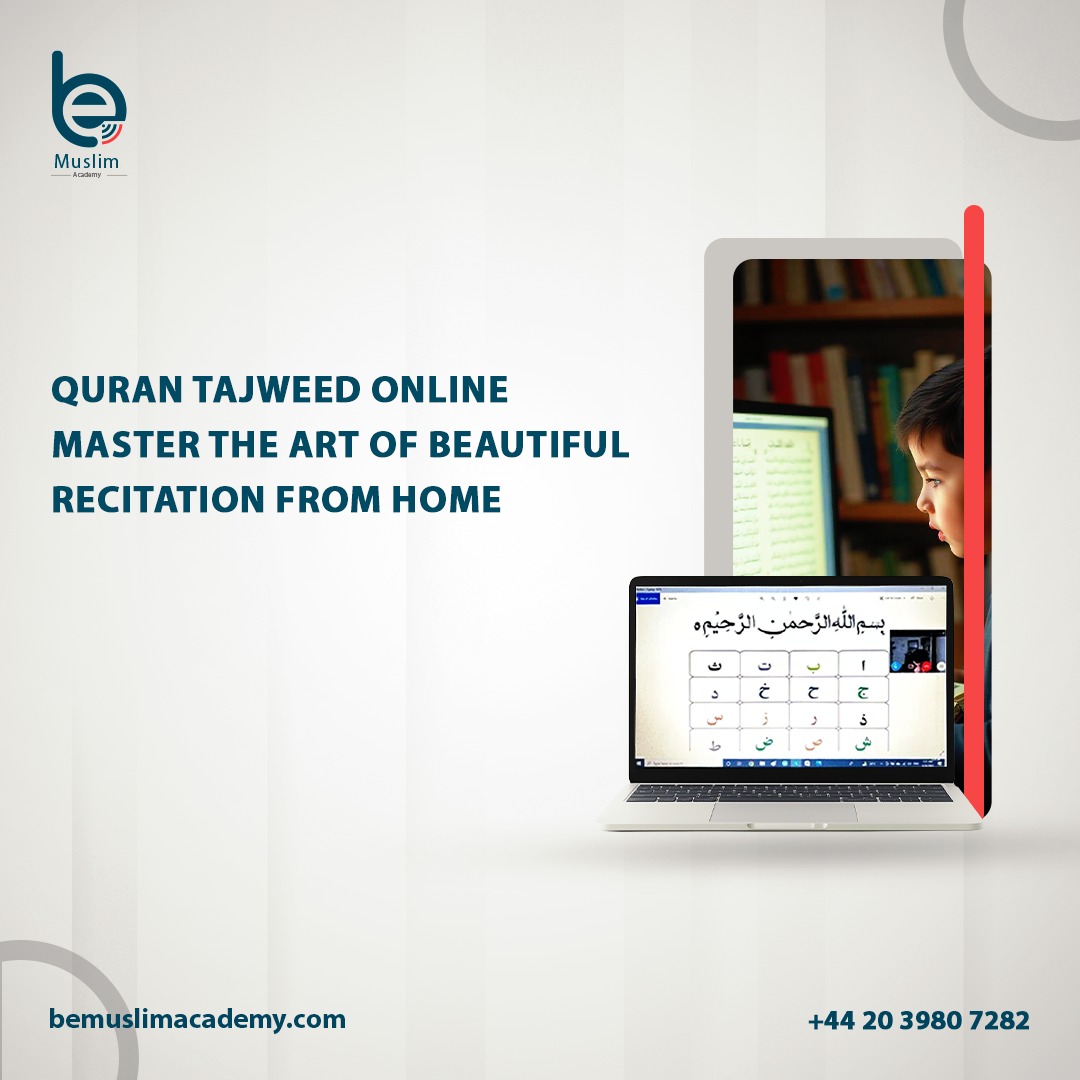
How is online Tajweed actually taught? A typical session is one-on-one over Zoom or a similar platform. The teacher shares their screen showing the Mushaf, points to the ayahs as you recite, listens to your pronunciation, and corrects in real time. Sessions are usually 30 or 60 minutes, two to five times a week depending on your plan.
What’s the difference between Noorani Qaida and Tajweed? Noorani Qaida is the primer — it teaches the Arabic alphabet, vowel marks, and basic letter combinations. Tajweed is the next step — it teaches the rules for reciting the Quran from the Mushaf. Most students complete Noorani Qaida first (usually 2–4 months), then move into Tajweed-applied Quran reading.
How long until my child can recite Surah Al-Fatiha with Tajweed? For a five-to-seven year-old starting from scratch, expect three to six months of consistent twice-weekly sessions before they can recite Al-Fatiha with applied Tajweed.
Can I choose a female Tajweed teacher? Yes. Female teachers are available for every course. Request this when booking your trial and the preference will be honoured every session.
Do you teach the qirāʾāt (variant recitations)? The default at Be Muslim Academy is Ḥafs ʿan ʿĀṣim, the most widely used qirāʾah worldwide. Other qirāʾāt are available for advanced students on request — discuss with your teacher.
Can I learn Tajweed alongside Hifz (memorisation)? Yes — and you should. Memorising without Tajweed builds long-term mistakes that are very hard to unlearn. Many academies teach the two in parallel: Tajweed on the verses being memorised, so the memorisation is locked in correctly the first time.
How much do online Tajweed classes cost in the UK? Typically £30–£60 per month for 30-minute sessions twice a week, or £50–£110 for 60-minute sessions, depending on the academy. At Be Muslim Academy, our pricing starts at £30 per month.
What equipment do I need? A smartphone, tablet, laptop, or desktop with a webcam, microphone, and stable internet. Headphones help reduce echo. A physical Mushaf for off-screen practice is highly recommended.
Are online Tajweed classes effective for adults who learned to recite as children? Yes — this is actually one of the most common starting points. Many adults can read the Quran but never received formal Tajweed instruction, and they’re carrying mistakes that have become habitual. A good teacher can systematically identify and correct those mistakes in three to six months of consistent study.
How do I know if my recitation is improving? A serious Tajweed course tracks this explicitly. You should expect monthly progress reports, periodic assessment recitations, and clear feedback on which rules you’ve mastered and which still need work.
Final Word
Tajweed is a long road, but it’s the road that turns reading Arabic into reciting the Quran. Every Muslim who has walked it says the same thing afterwards — that they wish they had started sooner.
The thing nobody tells you about Tajweed before you start is that the spiritual change happens alongside the technical progress. The more carefully you pronounce each letter, the more attention you pay to each word. The more attention you pay to each word, the more its meaning sinks in. The more meaning sinks in, the more the Quran shapes you. This is the deeper purpose of the science.
If we can help you start, we’d be honoured to. Book your two free trial sessions — no card required, no pressure to continue — and meet a teacher who can take you, or your child, wherever you want to go.